


New! UAS Sentry Nexus
- Aug 31
- 5 min read
Drone Sky Defender | August 31, 2026
Remote ID changed drone detection. Compliant aircraft now broadcast identity and location on 2.4 GHz and 5.8 GHz. The job of a receiver is no longer to invent a track from raw RF. It is to hear a weak, legal broadcast as far away, and as reliably, as the physics of the site allow.
That last part is where most systems stall. Reception is not a slogan. It is signal versus noise at the antenna, then whether the radio behind that antenna is free to listen.
UAS Sentry Nexus, now available through Drone Sky Defender, is built around that fact. The headline is modular hardware: three to 18 antennas, one LAN or LTE drop. The reason it hears better is quieter and more important. Every antenna gets its own processor, its own radio, and its own scanning algorithm.
What “reception” actually means in Remote ID
A Remote ID packet is a short burst. The drone is not trying to talk to your sensor. It is shouting into the air for anyone who can hear. Your site then adds the usual enemies of RF:
Distance and free-space path loss
Buildings, trees, and terrain that shadow 2.4 GHz and 5.8 GHz
Other Wi-Fi, video downlinks, and noise in the same bands
An antenna pattern that is strong in one direction and thin in another
A receiver that is busy scanning one frequency while a packet arrives on another
Published figures from earlier-generation setups were typically up to 3 miles mobile and up to 6 miles fixed, and even those numbers moved with height, clutter, and how hard the aircraft was transmitting. Nexus does not replace that with a new guaranteed mile rating. It changes the radio architecture so more of the energy that doesarrive at the site is captured, processed, and turned into an alert.
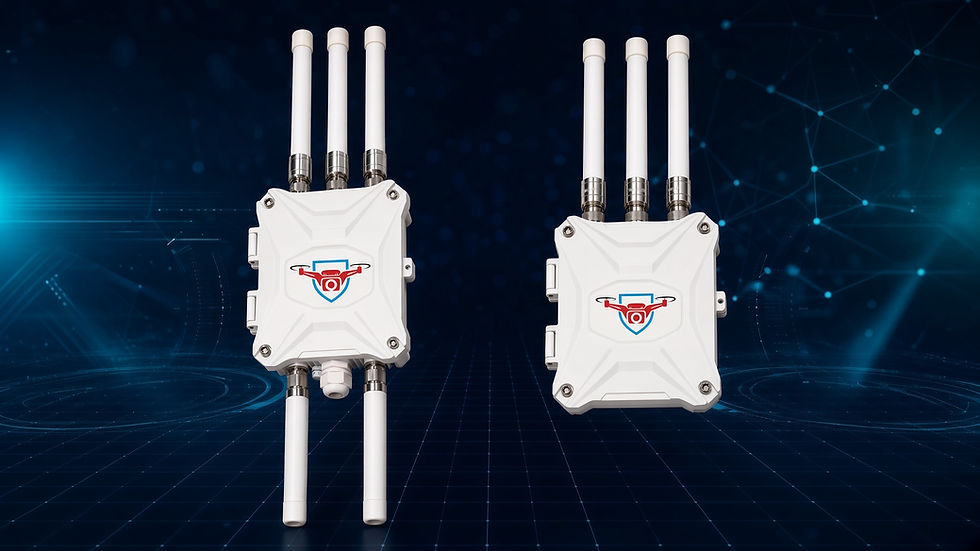
Standard PoE and Directional Antenna unit.
The old bottleneck: many antennas, one set of ears
Connecting extra antennas to a single receiver is a common shortcut. It looks like more coverage on a datasheet. In practice those antennas often share one radio. While that radio is tuned to one band, dwell, or algorithm, a packet on the other path can pass through unheard. Two antennas on one receiver are not two independent listeners. They are two mouths and one set of ears.
Nexus 3 starts with three independent processors. Each runs a dedicated radio and a distinct scanning algorithm. They talk to each other over a proprietary hardware bus, so they can cooperate without taking turns on a single tuner. The platform is designed to hear Remote ID on both 2.4 GHz and 5.8 GHz.
Add an expansion module and you add three more antennas and three more processors. The array can grow to 18 antennas. The site still uses one network connection. You are not deploying a new networked receiver every time you add a sector.
How that architecture improves reception
1. Nothing shares a radio.A packet that arrives on antenna 4 is processed by the radio behind antenna 4. It does not wait for another antenna’s scan cycle to finish. Detection probability at the edge of coverage goes up because the system is listening in parallel, not in sequence.
2. Directional antennas finally earn their gain.An omnidirectional antenna sprays sensitivity in a circle. That is convenient and wasteful. A 60-degree directional antenna concentrates gain into a sector. Higher gain in the direction that matters means a weaker packet still clears the noise floor.
Six 60-degree antennas for full 360-degree coverage. You do not give up the circle. You thicken it where approaches actually come from — a runway end, a facility fence, a river corridor, a stadium bowl.
3. You can measure reception instead of guessing it.Nexus analytics report RSSI per receiver at the same moment. You can hang an omni and a directional at the same site, fly or wait for real Remote ID traffic, and compare. That ends the old ritual of install one antenna, collect a week of data, swap it, hope the weather matches.
4. Height and placement still win — Nexus just lets you use them.Raising an antenna clears clutter and stretches the radio horizon. Type-N runs already allowed antennas to sit away from the enclosure. The new part is that each of those remote antennas can have a dedicated radio behind it, not a splitter.
5. The software still does the operational work.Better reception is wasted if nobody is notified. Nexus keeps circular, polygon, priority, and time-based geofences, whitelist and blacklist, classification, email and text alerts, CSV flight logs, historical identification, and the same open API existing integrations already use. The system is passive. It does not transmit to, command, or jam aircraft.
What this looks like on a real site
Most permanent installs will not need 18 antennas. The useful configurations are:
Configuration | What you get | Why reception improves |
Nexus 3 | Three dedicated radios | Parallel scan on both RID bands, no shared tuner |
Nexus 6 | Six dedicated radios | Full 360° with 60° directional sectors, or mixed omni + directional |
Expansion to 18 | Six modules of three | Extra sectors, extra height, extra comparison antennas — still one LAN or LTE drop |
A six-antenna Nexus 6 — Nexus 3 plus one expansion module — is priced under $10,000. That is six receivers, not six antennas sharing one. Customers with an active maintenance agreement may also apply 80% of the original purchase price of a qualifying receiver as credit toward Nexus 3 or Nexus 6, subject to terms and eligibility.
What Nexus does not claim
Reception is still physics. A directional array will not punch through a hill. A drone that is not broadcasting Remote ID will not appear as a Remote ID target. Interference, mounting height, and transmit power on the aircraft still set the ceiling.
Treat any coverage diagram as an architecture picture, not a survey. The honest improvement is this: more independent radios, aimed where you need them, measured against each other in real time. That is how you move detections outward toward the edge of a site instead of adding antennas that all wait on the same receiver.
Drone Sky Defender is introducing UAS Sentry Nexus with the August 31, 2026 launch at Commercial UAV Expo in Las Vegas. If you want a Nexus 3 or Nexus 6 scoped to a specific fence line, airfield, or campus, talk to us. Bring the site map. The antennas should follow the approaches — and each of those antennas should have its own radio.
Drone Sky Defender — Your sentinel of the skies. Upgrade credit is subject to terms, conditions, and eligibility. Detection distance depends on antenna type and gain, mounting height, terrain, interference, and the aircraft’s Remote ID transmit power.


Comments